|
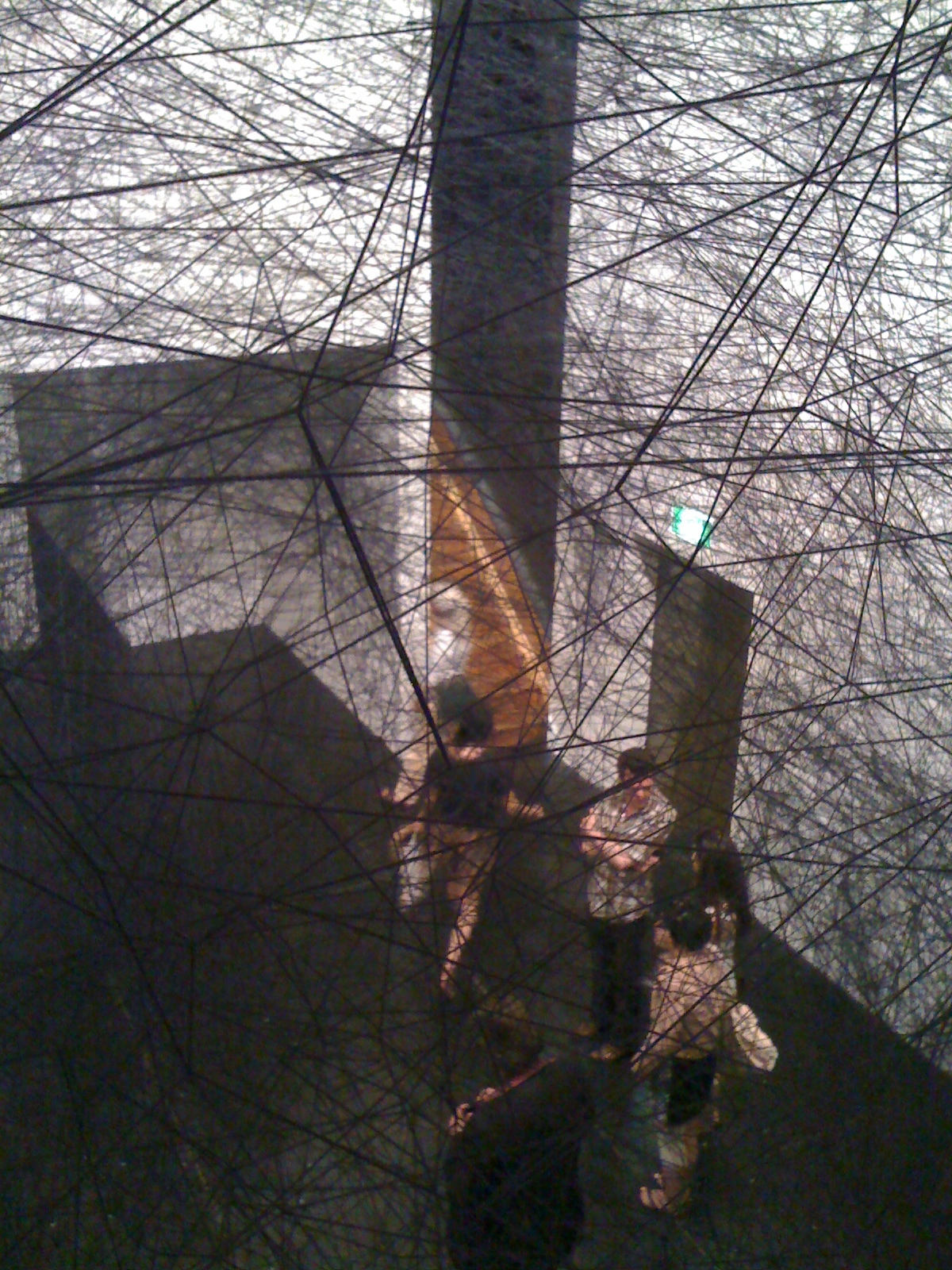
| My contribution to Ewa Partum's courtyard installation |
I spent last week traipsing around the Sydney Biennale – an exhibition that seems to be growing larger every year. The popular Cockatoo Island is used as
a site for the 3rd event running, as is Pier 2/3, the Museum of
Contemporary Art (MCA), the Art Gallery of New South Wales (AGNSW), and a new
addition: Carriageworks.
Unfortunately, there is nothing in the botanic gardens, which is
disappointing because many of my favourite works from the last biennales were sited
there.
 |
| Ricardo Lanzarini, Cockatoo Island |
The artworks on Cockatoo Island this year are, on the whole,
far more in dialogue with the site than previous years. We’re so used to viewing art against
‘neutral’ white walls that the constructed environment of the Modern museum has
almost become invisible.
Comparatively, when art is placed in complex semiotic sites where the
surrounding environment is very obvious and at risk of overwhelming the art,
it’s important that artists and curators take this into account.
Four years ago, I commented on the
Biennale’s promotion of ‘more than 30 site-specific’ artworks supposedly on
Cockatoo Island. As a buzzword,
site-specific art makes for good press releases, however punters are confused
when the works don’t actually relate to the site. This year’s Cockatoo Island artworks include some site-specific
artworks, but far more that are suitably installed in dialogue with the site
without being strictly site-specific.
For instance, Ricardo Lanzarini’s drawings in a utilitarian-looking room
on the top of the island are clustered near the pipes, doorways and other
existing features (The artist also has a series of intricately drawn books made
from cigarette papers displayed at the AGNSW).
 |
| The roofless structure that houses Tiffany Singh's installation |
Also notable is Tiffany Singh’s colourful wind
chime artwork installed in an oddly-shaped roofless structure on the western end of
the island. From the outside, the
bamboo chimes are barely audible, yet within the sandstone walled structure,
accessed by a small opening that requires the viewers to crouch on entry, the
hundreds of chimes clatter loudly with the movement of the wind. On a sunny day, the dark shadows cast
by the grid of coloured chimes and reverberating sound completely surrounds and
involves the viewer
 |
| Tiffany Singh, Knock on the Sky Listen to the Sound |
In keeping
with my obsession with artworks that construct the lives of fictional people
within exhibition spaces, I appreciate Iris Haussler’s He Dreamed Overtime, sited in a cracked sandstone house on the top
island. However, when I challenge
the invigilators on the story of the mysterious island caretaker, it is obvious
they needed a bit more lying practice.
 |
| Iris Haussler's He Dreamed Overtime (installation shot) |
 |
| Nicholas Hlobo, Ingubo Yesizwe |
 |
| Peter Robinson, Gravitas Lite |
I also enjoy Nicholas Hlobo’s kelp-like installation, Ingubo
Yesizwe in the Docks Precinct, where it’s
initially unclear whether the mound of sewn black rubber, slumped on a boat
ramp, is an artwork. There’s no
fancy lighting or plinths here.
Peter Robinson’s epic mound of carved polystyrene chains, which sit on,
around, and within the rusty machinery in the Industrial Precinct, also relates
nicely to the site, the (for now) white plastic contrasting with the darkened
waste. Once I get over my initial
‘yeah, so, you can carve a chain, so what?’ (yes, I’m petty), it’s clear that in its scale and material,
the installation is very successful.
Nearby are Philip Beesley’s Avatar-like hanging objects, Hylozoic
Series, which react to the viewers’ touch
and movement.
 |
| Philip Beezley, Hylozoic Series (detail) |
As one of my friends remarked, the island is populated with
‘floaty’ artworks. Adjacent to
Beesley’s work are Ed Pien and Tanya Tagaq’s hanging fabric and rope mazes
(supposedly representing rain), and Monika Grzymala’s installation completed
with the Euraba Artists and Papermakers, which looks like seedpods being blown
away in the wind in suspended animation.
While these three installations aren’t site-specific, they sit
comfortably in the tall warehouse spaces
 |
| Erin Manning, Stitch in Time - A Collective Fashioning, installation shot |
 |
| Li Hongbo, Ocean of Flowers |
The ‘floaty’ artwork by Erin Manning, on the other hand, looks like
something unfortunate washed up from Byron Bay, where scraps of hanging fabric
and tulle surround a project table set up with thread and needles. The work on the warehouse floor below –
Li Hongbo’s Ocean of Flowers - is more
considered. The clusters of
colourful accordion paper sculptures form a cartoon-like landscape though which
viewers are allowed to walk.
Later, we are shown the shapes that form the basis of these happy
looking objects: guns and bullets.
To be honest, I’m disappointed that the work can’t just be about the
objects, that it had to be made out of war-associated objects. Like Pien and Tagaq’s artwork, the
installation is made more complex than it needs to be.
 |
| The basis of Li Hongbo's paper sculptures |
|
|
|
 |
| Jonathan Jones, Untitled (Oysters and Teacups) |
As with the 2008 biennale, the iconic island tunnels are
used for site-specific artworks.
Clustered around the bend in the Dog-Leg tunnel, Daan Roosegaarde’s
light poles interact with the viewers’ movement. Jonathan Jones’ ubiquitous geometrically arranged
fluorescent lights are also triggered by our passage through the shorter Tunnel
1 (his other artwork is pictured left). Jon Pylypchuk’s Esky miner
creatures digging away at the northern end of the Dog-Leg are a humorous
addition to the cave-like annex.
 |
| Jon Pylypchuk, Spend the Rest of Your Life Mining this Death and it Will Only Bring You Dispair |
Near the entrance to the tunnel is part of Fujiko Nakaya’s moody fog
sculpture, which follows a similar work by the artist exhibited in the 1976
Sydney Biennale. (Now for some
trivia:) The 1976 work was renamed and installed site-specifically in the
sculpture garden at the National Gallery of Australia in Canberra – a place
that, unlike Cockatoo Island, probably doesn’t need any more fog.
 |
| Looking out of the warehouse towards Fujiko Nakaya's fog sculpture (clouds extra) |
 |
| Pinaree Sanpitak, Anything Can Break, MCA |
As I wrote earlier, the Biennale includes a substantial
number of works, and while the island’s scale to an extent relieves the
perception of overcrowding, the MCA is not so lucky. Crowding aside, the MCA’s exhibition is pretty
disappointing. The comparison
between the excellent exhibition of the museum’s acquisitions on level 2, and
the underwhelming and congested biennale installation on 1 and 3, is pretty
indicative.
The Biennale exhibition at the AGNSW is separately titled In
Finite Blue Planet, complying with the art
world’s current love of separ at ing wo rds (and its rarely for obvious
reasons). Evidently, the
exhibition’s focus is on environmental concerns, however, there seems to be far
stronger threads relating to craft, labour and work. Gao Rong’s trompe l'oeil life-sized domestic interior
diorama is painstakingly hand embroidered, Hassan Sharif’s installation
consists colourful piles (each a separate artwork) of obsessively wrapped found objects, and Nipan
Oranniwesna’s fragile City of Ghost
is an intricate map formed with scented baby powder (I witness a child write
his name in it on the biennale’s second day. Good luck, invigilators). Then there are the delicate cut-outs: Yuken Teuya’s Notice-Forest:
Six Jewels carved out of branded paper
shopping bags, and Jorge’s Macchi’s altered world map.
 |
| Hassan Sharif, various works (1985-2007) |
The star of the biennale is Cockatoo Island,
which has been the case for the last three events. Then again, perhaps it’s as much to do with the spectacular
machinery and nostalgic industrial fetish as the art itself.
 |
| ...and maybe the Island Bar. |