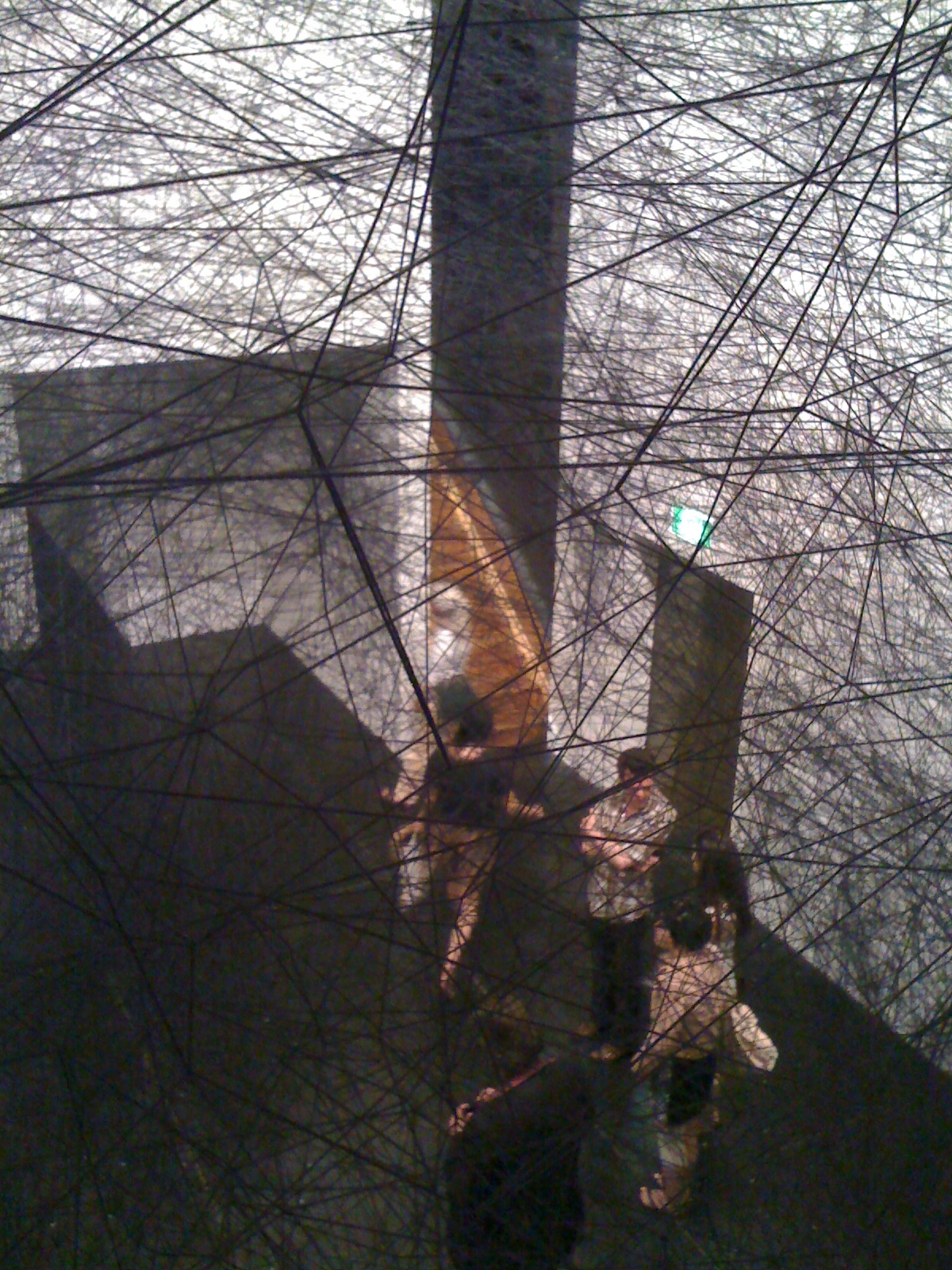
Tell me about your art practice.
It’s about exploring our relationship to language, to books,
to the way we store and sort information, to codification, and to an essential
mystery I see associated with the process of writing. It’s inspired by my love of books and literature and
libraries. My interest in all these things stems from growing up in a family
where we spoke Latvian as well as English, and my parents spoke a number of
different languages so I’ve been fascinated, or exposed always to this idea of
different ways people express themselves.
When I speak Latvian, something different that happens in my brain, the
way I express myself and my thinking. There’s something slightly different
there and I think it changes with each language. They’re the concepts underpin
my ideas, that I’m interested in conveying - our complex and paradoxical
relationship to language. On one hand language is an extraordinary tool. It enables
us to express our thoughts and ideas and our feelings, and to describe our
place in the world, but at the same time it’s not an accurate reflection of
reality. It’s something in a constant state of flux and change. And it changes as our perceptions of
the world and our understanding of the world changes. I’m interested in trying
to convey that gap between reality and what language does. That’s where the
mystery is for me. I think we have this paradoxical relationship to language as
a result of that. One of the key strategies I’ve used in my works is to promise
meaning but also deny access to meaning.
Could you give me example?
In Kryptos, the walls
are lined with binary code. As you enter Kryptos and experience it more and more, you start to see
there are some English words in amongst the code. There is this promise of
meaning embedded in this code, that it’s not simply patterns of zeros and ones
on the walls… but ultimately the viewer’s access to that meaning is denied.
Hopefully you get a tantalising glimpse where you may start to question your
own relationship to language.
Does that mean the artist statement is key to interpreting
the work?
I like to think that people can have an experience in my
work that affects them. They can have an experience about the work – a rich
experience – without having to know my specific intentions. People might go
into Kryptos and say ‘oh wow, I loved
being in that work’, but they don’t need to know that the text is from the Epic
of Gilgamesh, and that it’s to do with a
man coming face to face with his own mortality as Gilgamesh does.
I think that’s an indicator of a successful artwork, and one
of the things I like about Kryptos:
you can read the artist statement if you wish, but really you can enter the
work from any level.
And that’s my aim. People say ‘oh wow, now you’ve told me
about the Epic of Gilgamesh, I feel as
if I really understand what the work is about.’ But I don’t think that way.
Reading my artist statement and finding out what I was thinking and so on may
add some other dimensions to your understanding of the work, but I really don’t
think it’s necessary to get that work.
I’m not sure if it’s the same with my new installation. Graphos is a response to Mark Changizi’s ideas [on the
origin of art], which are very specific and from a scientist’s point of view.
I’ve tried to create another experience that evokes his ideas but is also
poetic in some way.
He tells us that language is all around us. We develop it
because of our relationship to nature and the world around us. We see certain
objects in relation to each other... we see angles and lines and intersections
that then become the basis of an alphabet in any language. [However, his
interest is in] the formal structure of language, whereas I’m more interested
in the content and meaning of what we say.
I was drawn to Changizi’s minimalist diagrams in his book [The
Vision Revolution], and the three large
objects [in Graphos] come
directly from his diagrams. The first thing I thought of … was the work of the
1960s Minimalists like Robert Morris and Donald Judd.
Yeah, I was reminded of Robert Morris’ L Beams when seeing your work.
It’s an obvious conversation that I’m having with 60s
Minimalists. But my work’s created out of wood, so that’s my reference to
nature and the world around us. The objects also contain sound. One thing
Changizi says is that the actual forms of language come from seeing objects in
relationship to nature in the natural world. He says the actual sounds of
language come from the sound of body in motion in the world, and basically from
three types of sound: hits, slides and rings. It might be the stamp of a foot,
a body hitting something and the reverberations that come from that. I
interpreted those things as quite percussive sounds, and so they’re the sounds
you get in Graphos. I think they’re a
little avant-garde, a little bit 50s and 60s. They have an experimental beatnik
sound to them. But then you get voices intermingled with that that are sounding
out the phonemes of the words that line the walls of Graphos, which say ‘around us everything is writing’. Those
words are a direct quote… from a beautifully poetic work by the late Marguerite
Duras … about what it is to be a writer and the process of writing.
Changizi says a similar thing, but from the viewpoint of the
scientist: that writing is everywhere. I think writing is embedded in the world
around us. So Graphos is the merging of
the scientist, the writer and the visual artist. They’re three different ways
of thinking about writing, but they have interconnections.
Both works have a really interesting relationship to the
human body through scale and movement. That was something the Minimalists were
doing too – L-Beams was
designed to be walked around and viewed in relation to the space and the body.
I was thinking about the relationship people would have to
the forms in the space, but I was also thinking about the dimensions of the
space and the size you would need to command the space in a particular
way.
But I’m also quite practical as an artist, and I designed
them to the standard sizes that the plywood panels come in because it makes it
so much easier to construct. It’d be really interesting to look at the origin
of those dimensions. It’d be related to what the human body can make
practically and also handle.
It’s similar to the standardisation of photographs and
paintings. Why are they usually rectangular and hung in ‘landscape’ or
‘portrait’ orientations?
Yes exactly. So my objects work with those standard
dimensions, which also gives them a sense of proportion.
One thing that I notice in your installations is a sense
of excitement, play and anticipation.
I think that really works in Kryptos. In Graphos it’s a different experience because you don’t have separate spaces.
It’s one big all-encompassing space. A number of people have said to me that
they enjoy being in there, that it feels very warm and comforting. The wood
makes them reasonably sensuous objects that you would like to go up and stroke.
It’s quite different to Kryptos
which creates a little bit of anxiety.
One is very cold and the other very warm.
Yeah, one’s a crypt really. It uses concrete steel and glass
– materials that are naturally cold. Whereas Graphos uses organic materials –
it’s all wood. There’s this idea
that it’s still breathing and contracting and changing with the environment in
a different way to steel and concrete, which are manmade materials.
Although to be fair, plywood is manmade.
Yes, but it’s still made of wood.
I was buying my sister’s new baby a toy the other day, and I
thought back to Roland Barthes’ essay on plastic where he talks about wood with
its warmth and soft sound.
We do respond to wood. I don’t like glass tables. I think
it’s slightly scary. That timber and the rich grain in parts of it with those
embedded letters feels inviting and all encompassing. It’s that idea of ‘around
us everything is writing’.
Lastly, why do you make art?
For me, it’s a way of thinking in three or four dimensions.
It’s a way of realising my thoughts physically, and it’s a way of distilling a
lot of seemingly disparate thoughts, or seemingly disparate thoughts and
interconnections between ideas. Art can
be a combination of anything and everything that you’re thinking and that
you’re interested in. In art, I can combine my love of literature, my love of
film, a phrase that I’ve read in a book, or heard in a film that evokes a
powerful idea about something. It can combine all my interests and passions.
Then the great challenge as an artist is to distil those ideas into something
three-dimensional - or four-dimensional if I’m using sound or time-based media -
into something that makes your thinking concrete. It’s like the process of
writing. Writing allows me to think. It’s only through
the process of writing that my thoughts become real. [Making art is] a similar process in that it enables me to see my ideas
and extend them even further. And sometimes when you make art you don’t realise
what those thoughts are until years later. You review the work in a different
way from what you did at the time you were making it. You do some writing at
some point in time, and then you express thoughts at that time, and then later
on you read it and you go ‘oh hey, there’s some really interesting ideas –
things that I haven’t quite expanded on.’ It’s a form of thinking and
understanding your place in the world.
Visit www.brigitaozolins.com for images.
A shorter version of this interview was published in Warp Magazine, December 2016.
Disclosure note: The interviewer is a Mona employee.